

Read Online Cloud-Digital-Leader Test Practice Test Questions Exam Dumps
Easily To Pass New Cloud-Digital-Leader Premium Exam Updated [Jun 22, 2026]
Google Cloud Digital Leader Certification Exam is designed for individuals who are interested in establishing their expertise in the digital transformation domain. Cloud-Digital-Leader exam is designed to test the capability of an individual in developing and implementing digital strategies that can enhance business performance. Google Cloud Digital Leader certification exam is suitable for professionals who want to gain a strong understanding of the digital landscape and learn how to leverage digital technologies to drive business growth.
Google Cloud-Digital-Leader (Google Cloud Digital Leader) Exam is a certification exam designed for individuals who are interested in demonstrating their knowledge and skills in Google Cloud Platform (GCP) technologies. Cloud-Digital-Leader exam is intended for professionals who want to validate their expertise in designing and implementing cloud-based solutions using GCP services.
The Google Cloud-Digital-Leader exam consists of multiple-choice questions and is administered online through the Google Cloud certification portal. Cloud-Digital-Leader exam is timed, and individuals have 2 hours to complete it. A passing score is required to receive the certification, and the certification is valid for two years.
NEW QUESTION # 215
An employee receives an email from their internet service provider asking for their bank account number and password.
Which cybersecurity threat is this?
- A. Distributed Denial of Service
- B. Ransomware
- C. Phishing
- D. Spamming
Answer: C
Explanation:
The difference between spam and phishing is that, while they both may be inbox-clogging nuisances, only one (phishing) is actively aiming to steal login credentials and other sensitive data. Spam is a tactic for hawking goods and services by sending unsolicited emails to bulk lists
NEW QUESTION # 216
A financial services company is running an experimental application workload that has a very large number of mathematical calculations involving floating-point numbers. The current application that is running on compute engine is not providing enough speed and throughput. What are the options to increase the processing performance?
- A. Instead of using a "general purpose" machine family, use "compute-optimized" machine family.
- B. Attach GPUs to the virtual machine for number crunching.
- C. Use a serverless option like Cloud Functions that will automatically scale as much as required.
- D. Since processing could also be dependent on reading and writing data to the disk, use a fast Local SSD.
Answer: B
Explanation:
Explanation
Compute Engine provides graphics processing units (GPUs) that you can add to your virtual machines (VMs).
You can use these GPUs to accelerate specific workloads on your VMs such as machine learning and data processing.
https://cloud.google.com/compute/docs/gpus
NEW QUESTION # 217
When creating machine learning models, a key initial step is to identify the type of model required. One of these is the classification model. Which of these statements define a classification model?
- A. A type of machine learning model that outputs continuous (typically, floating-point) values. E.g. the predicted price of the house is $120,000.
- B. A type of machine learning model for distinguishing among two or more discrete values. E.g. "book",
"car". - C. A type of classic model approach that is less used today and which has been re-placed by the regression model.
- D. A type of machine learning model is a meta-model maker, which classifies algo-rithms based on the quality of their output.
Answer: B
Explanation:
Explanation
A classification model classifies the incoming data into one or more discrete classes.
NEW QUESTION # 218
What is monitoring within the context of cloud operations?
- A. Tracking user activities to guarantee compliance with privacy regulations
- B. Collecting predefined and custom metrics from applications and infrastructure
- C. Tracing user location to document regional access and utilization
- D. Observing cloud expenditure in real time to ensure that budgets are not exceeded
Answer: B
NEW QUESTION # 219
You are working in a company that provides different services to its customer. Now it also wants to offer some paid API services to its B2B customers for e.g. google provides google maps API, cloud vision API, and language translation API. You need to figure out the best solution for the service.
- A. Apigee API Management
- B. Cloud Functions with Firestore and payment gateways integration development.
- C. Frontend & Backend Development with NodeJs and angular etc.
- D. Java Programming Spring Boot Framework for to solve the problem of APIs man-agement.
Answer: A
Explanation:
Explanation
A top-level idea about Apigee API Management and its offered features can help you solve all questions related to Apigee in Cloud Digital Leader Practice Exam.
Apigee is a platform for developing and managing APIs. By fronting services with a proxy layer, Apigee provides an abstraction or facade for your backend service APIs and provides security, rate limiting, quotas, analytics, and more.
Apigee services: The APIs that you use to create, manage, and deploy your API proxies.
Apigee runtime: A set of containerized runtime services in a Kubernetes cluster that Google maintains. All API traffic passes through and is processed by these services.
NEW QUESTION # 220
Which of the followings are core components of Anthos?
- A. Secure software supply chain
- B. Infrastructure, container, and cluster management
- C. Multicluster & Configuration management
- D. All of the above are correct.
Answer: D
Explanation:
Table Description automatically generated
NEW QUESTION # 221
Your company has made plans to roll out OpenShift, a Kubernetes platform solution offered by IBM Red Hat, across all its on-premises and public cloud environments. Given that you are the lead architect responsible for your company's GCP deployments, what type of shared responsibility model will this deployment entail for you?
- A. On premises
- B. PaaS
- C. IaaS
- D. SaaS
Answer: C
Explanation:
The key to remember here is that for a service provided (GCP in this case) to take responsibility for its PaaS, it must offer the service as a managed service. GCP offers its own Kubernetes platform called GKE. But OpenShift is not a Google-offered PaaS solution. As such, Google will not take responsibility for the back-end operations and design of your OpenShift environments. You will need to manage all the VMs that OpenShift will provision as part of its GCP deployment. So this is an IaaS deployment from a shared responsibility model perspective.
NEW QUESTION # 222
Your organization is releasing its first publicly available application in Google Cloud. The application is critical to your business and customers and requires a 2-hour SLA.
How should your organization set up support to minimize costs?
- A. Enroll in Enhanced Support
- B. Enroll in Basic Support
- C. Enroll in Premium Support
- D. Enroll in Standard Support
Answer: A
Explanation:
Reference:
SecureAuth is dedicated to providing the industry-leading enhanced support ensuring the long term success of your SecureAuth SaaS IAM deployment
NEW QUESTION # 223
An organization is building advanced machine learning models in Google Cloud by using TensorFlow. They want to develop their models faster with purpose-built hardware. Which solution should the organization use?
- A. TPUs
- B. CPUs
- C. DPUs
- D. GPUs
Answer: A
NEW QUESTION # 224
Which technology allows organizations to run multiple computer operating systems on a single piece of physical hardware?
- A. Open source
- B. Hypervisor
- C. Containers
- D. Serverless computing
Answer: B
NEW QUESTION # 225
Your organization consists of many teams. Each team has many Google Cloud projects. Your organization wants to simplify the management of identity and access policies for these projects.
How can you group these projects to meet this goal?
- A. Use folders to group each team's projects
- B. Assign labels based on the virtual machines that are part of each team's projects
- C. Group each team's projects into a separate domain
- D. Group each team's projects into a separate organization node
Answer: A
Explanation:
https://cloud.google.com/resource-manager/docs/creating-managing-folders
NEW QUESTION # 226
A partner of yours used to have their own private data center. Your company was already on Google Cloud and now they have also moved to Google Cloud. You are investigating whether there are ways to collaborate better or shared services. What would be one good option to consider?
- A. Use public IP addresses as before. It will automatically be routed internally only.
- B. Use VPC Peering to share resources privately between your two organizations.
- C. Use VPC Shared Networks to share common resources.
- D. Use Private Service Access within Google Cloud.
Answer: B
Explanation:
Explanation
VPC Network Peering allows internal IP address connectivity across two Virtual Private Cloud (VPC) networks regardless of whether they belong to the same project or the same organization.
-> Shared VPC is only within an organization - it allows an organization to connect resources from multiple projects to a common Virtual Private Cloud (VPC) network, so that they can communicate with each other securely and efficiently using internal IPs from that network.
-> Private Google Access is only to access Google APIs and services
References:
-> https://cloud.google.com/vpc/docs/vpc-peering
-> https://cloud.google.com/vpc/docs/private-google-access
-> https://cloud.google.com/vpc/docs/shared-vpc
NEW QUESTION # 227
How would a global organization benefit from managing their data with Cloud Spanner?
- A. Cloud Spanner is optimized for cold storage
- B. Cloud Spanner is optimized to ingest unstructured data
- C. Cloud Spanner visualizes and analyzes data in real time
- D. Cloud Spanner replicates data across regions in real time
Answer: D
Explanation:
Explanation
Spanner is Google's scalable, multi-version, globally-distributed, and synchronously-replicated database.
NEW QUESTION # 228
An organization meets their service level objective (SLO) of 99 999% ("five nines") How much downtime do their end users experience per year?
- A. 5 days
- B. 500 minutes
- C. 5 hours
- D. 5 minutes
Answer: D
NEW QUESTION # 229
What would provide near-unlimited availability of computing resources without requiring your organization to procure and provision new equipment?
- A. Microservices
- B. Public cloud
- C. Private cloud
- D. Containers
Answer: B
Explanation:
Reference:
NEW QUESTION # 230
You are working in a company where you need to store Terabytes of Image Data daily and process them e.g.
Taking photos of the entire planet 24 hours every day with satellite and sending data to data centres to store and process it. Which of the following would be the best combination for your infrastructure.
- A. None of the Above
- B. Google Cloud Storage & Google Cloud Compute Engines
- C. Google Cloud Storage & Preemptible VMs.
- D. Bare Metal Solutions with Google Cloud Storage.
Answer: C
Explanation:
The above is a real world example of a company named Planet, where they sent around 80+ satellites to take pictures of earth every day, 24 hours. They run around 40,000 preemptible VMs concurrently.
Preemptible instances function like normal instances but have the following limitations:
Compute Engine might stop preemptible instances at any time due to system events. The probability that Compute Engine will stop a preemptible instance for a system event is generally low, but might vary from day to day and from zone to zone depending on current conditions.
Compute Engine always stops preemptible instances after they run for 24 hours. Certain actions reset this 24- hour counter.
Preemptible instances are finite Compute Engine resources, so they might not always be available.
Preemptible instances can't live migrate to a regular VM instance, or be set to automatically restart when there is a maintenance event.
Due to the above limitations, preemptible instances are not covered by any Service Level Agreement (and, for clarity, are excluded from the Compute Engine SLA).
The Google Cloud Free Tier credits for Compute Engine do not apply to preemptible instances.
Reference link- https://cloud.google.com/compute/docs/instances/preemptible
NEW QUESTION # 231
What characteristics should an organization adopt to be a DevOps organization?
- A. Obsession with Automation over preoccupation with manual work
- B. Product based teams over component teams.
- C. All of the Above
- D. Teamwork over individual work
Answer: C
Explanation:
NEW QUESTION # 232
You are working with a user to set up an application in a new VPC behind a firewall and it is no-ticed that the user is concerned about data egress. Therefore, to provide assistance you want to con-figure the fewest open egress ports. Which of the following statement is correct?
- A. Set up a low-priority (65534) rule that blocks all egress and a high-priority rule (1000) that allows only the appropriate ports.
- B. Set up a high-priority (1000) rule that blocks all egress and a low-priority (65534) rule that allows only the appropriate ports.
- C. Set up a high-priority (1000) rule to allow the appropriate ports.
- D. Set up a high-priority (1000) rule that pairs both ingress and egress ports.
Answer: A
Explanation:
Explanation
Implied rules Every VPC network has two implied firewall rules. These rules exist, but are not shown in the Cloud Console:
Implied allow egress rule. An egress rule whose action is allow, destination is 0.0.0.0/0, and priority is the lowest possible (65535) lets any instance send traffic to any destination, except for traffic blocked by Google Cloud. A higher priority firewall rule may restrict outbound access. Internet access is allowed if no other firewall rules deny outbound traffic and if the instance has an external IP address or uses a Cloud NAT instance. For more information, see Internet access requirements.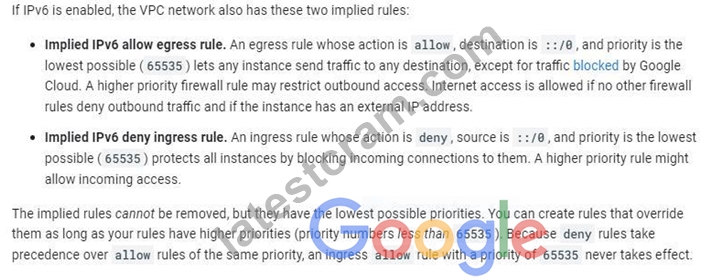
Reference link- https://cloud.google.com/vpc/docs/firewalls
NEW QUESTION # 233
What is the Site Reliability Engineering (SRE) term for an organizations desired level of reliability and performance?
- A. Scalable infrastructure
- B. Service-level objective
- C. Service-level indicator
- D. Enhanced support
Answer: B
Explanation:
The correct answer is D. Service-level objective. Here's why:
* Context of the Question: The organization wants to understand the term used in Site Reliability Engineering (SRE) for defining the desired level of reliability and performance.
* Google Cloud Product Relevance:
* A Service-Level Objective (SLO) is a key term in SRE, representing the target level of reliability or performance for a specific service. SLOs define acceptable levels of service in terms of availability, latency, or other performance metrics. They are used to set clear expectations and help measure whether services meet the desired reliability levels.
* SLOs are closely tied to Service-Level Agreements (SLAs) and Service-Level Indicators (SLIs), where SLIs measure specific aspects of service performance, and SLOs set the target levels based on those indicators.
* Why Not Other Options:
* A. Enhanced support: This is a support option for Google Cloud customers and is not related to SRE concepts.
* B. Scalable infrastructure: This refers to cloud infrastructure's ability to scale resources up or down but is not specific to reliability and performance metrics.
* C. Service-level indicator: An SLI measures a specific aspect of the service's performance but does not define the target level of performance.
Google Cloud Digital Leader References:
* Refer to the Site Reliability Engineering (SRE) documentation to learn more about SLOs, SLIs, and SLAs.
NEW QUESTION # 234
Your multinational organization has servers running mission-critical workloads on its premises around the world. You want to be able to manage these workloads consistently and centrally, and you want to stop managing infrastructure.
What should your organization do?
- A. Migrate the workloads to multiple local co-location facilities
- B. Migrate the workloads to a public cloud
- C. Migrate the workloads to multiple local private clouds
- D. Migrate the workloads to a central office building
Answer: C
NEW QUESTION # 235
Your ed-tech start-up was originally launched in a small geography. Any user sign-ups, course progress, tests taken, etc. are captured on a self-managed MySQL database. Every user generates many such transactions.
Now you're taking the application globally and preparing for a much larger influx of users from all over the world. The existing MySQL server is unlikely to be able to scale. Which convenient option can be considered?
- A. Migrate to BigQuery
- B. Migrate to Bigtable
- C. Migrate to Cloud SQL
- D. Migrate to Cloud Spanner
Answer: D
Explanation:
Cloud Spanner is a global scale SQL database that scales extremely well. That would be the best choice.
NEW QUESTION # 236
Which of the following statements is/are true about Google Cloud BigTable?
- A. It can not be used in Real-time Ad analytics and tracking thousands of IoT Devices Data.
- B. It is an enterprise-level Database that offers relational and non-relational features
- C. It Scales from Giga Byte to Peta Byte with No Downtime.
- D. It is not compatible with Hadoop.
Answer: C
Explanation:
Explanation
Cloud Bigtable
A fully managed, scalable NoSQL database service for large analytical and operational workloads with up to
99.999% availability.
- Consistent sub-10ms latency-handle millions of requests per second
- Ideal for use cases such as personalization, ad tech, fintech, digital media, and IoT
- Seamlessly scale to match your storage needs; no downtime during reconfiguration
- Designed with a storage engine for machine learning applications leading to better predictions
- Easily connect to Google Cloud services such as BigQuery or the Apache ecosystem
NEW QUESTION # 237
......
Cloud-Digital-Leader Certification All-in-One Exam Guide Jun-2026: https://examboost.latestcram.com/Cloud-Digital-Leader-exam-cram-questions.html
